Motivation
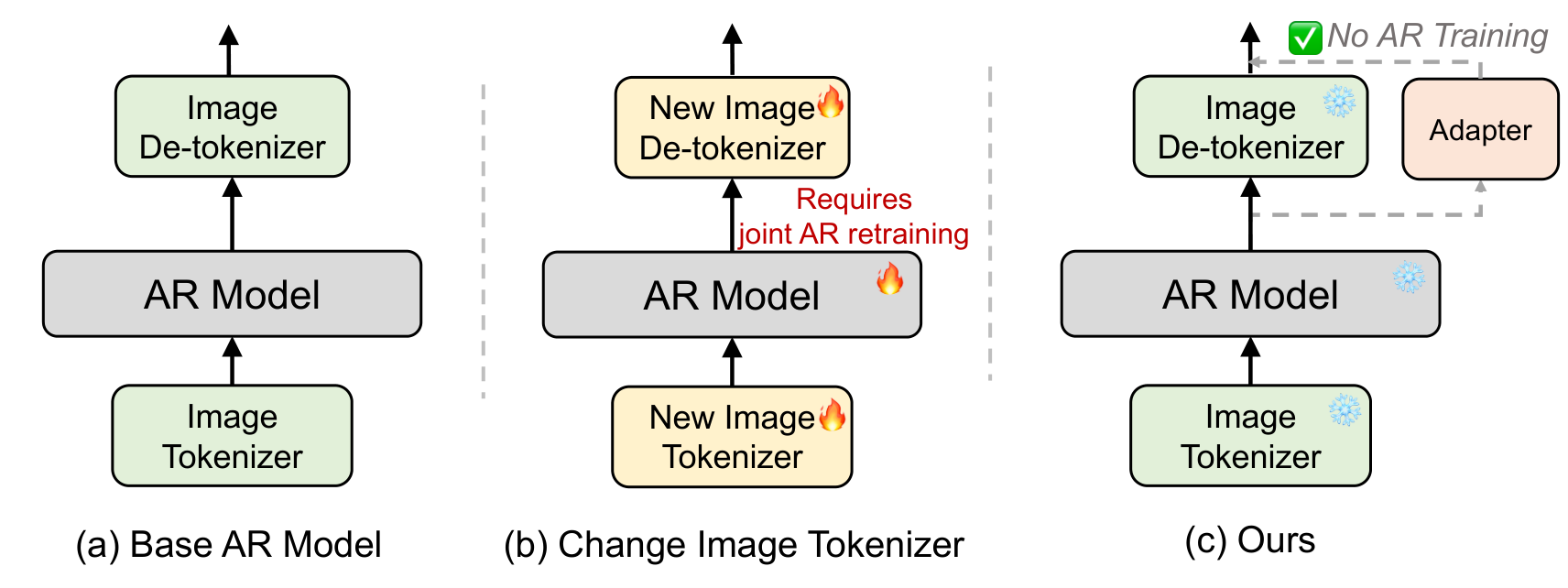
Visual Autoregressive (AR) models generate images by predicting discrete tokens that are decoded by a visual tokenizer. Despite demonstrating strong overall image generation ability, they still underperform on text rendering—producing blur strokes and disrupted letter shapes. We trace this limitation to the visual tokenizer, which struggles to reconstruct fine-grained detail.
Improving the tokenizer is straightforward but expensive, as it necessitates retraining both the tokenizer and the AR model. Can we improve text rendering performance of AR models without retraining the existing tokenizer and AR model?
To achieve this, we propose the Residual Decoder Adapter (RDA) that upgrades an existing tokenizer post-hoc without changing its token space. Specifically, it refines the decoder output of the visual tokenizer by introducing two novel components: (i) a paired Hint Codebook that shares the token distribution with the original one; and (ii) a Residual Decoder that learns the tiny differences (residual) between the reconstructed image and the ground-truth images in pixel space. This residual design allows us to enhance the tokenizer non-invasively while preserving compatibility with prior AR models.
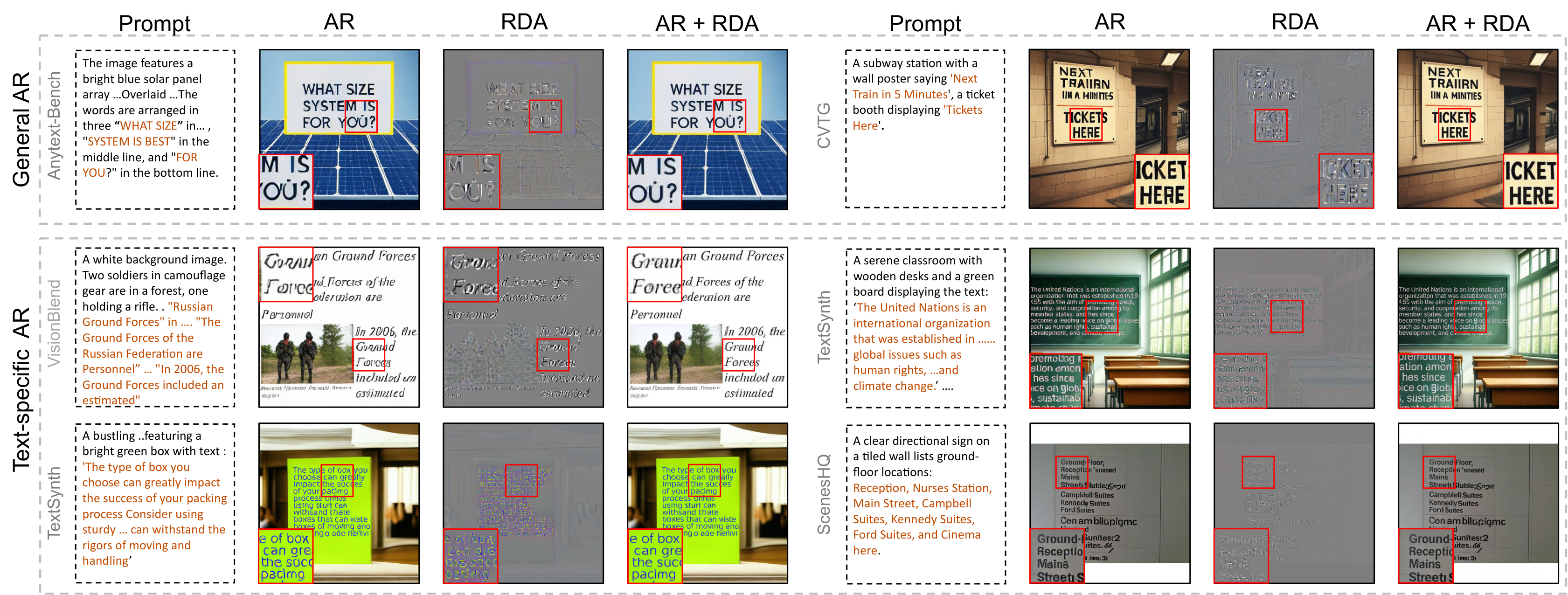
RDA substantially improves text rendering by a large margin. For instance, we boost finetuned Janus-Pro OCR accuracy from 24.52% → 58.26% (TextVisionBlend) and from 12.75% → 36.81% (StyledTextSynth) on the competitive TextAtlas benchmark.
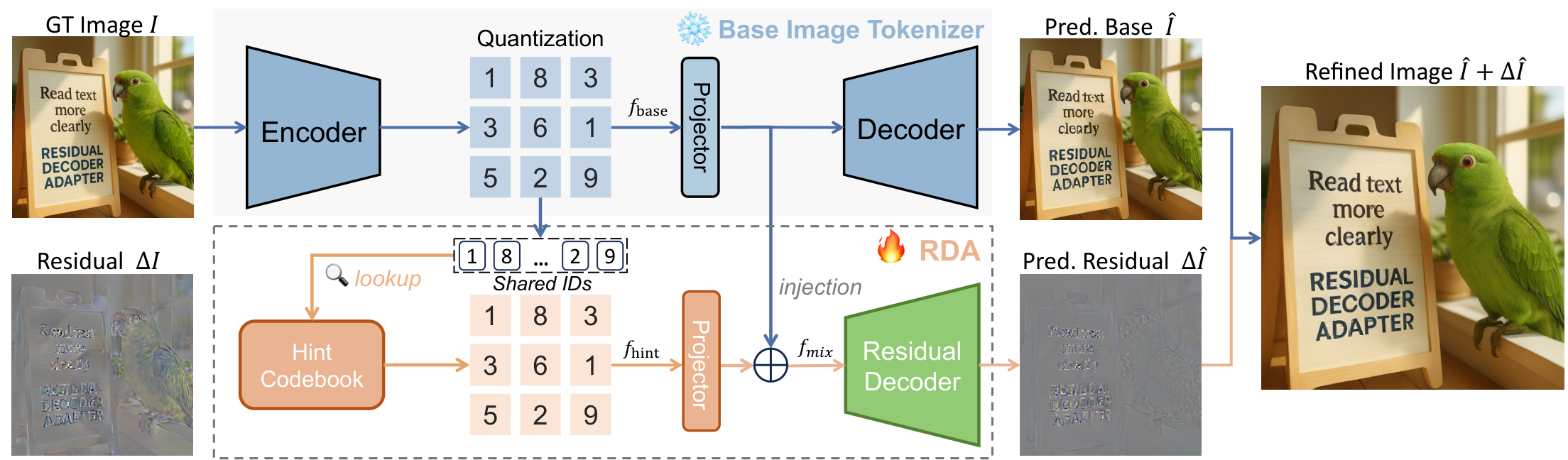
RDA keeps the original tokenizer frozen and attaches a lightweight Shared-ID Hint Codebook and Residual Decoder to recover fine-grained details lost during quantization—without changing the token space or retraining the AR model.
A unified benchmark board with dataset buttons: switch between the overview table and focused benchmark views without leaving the Results section.
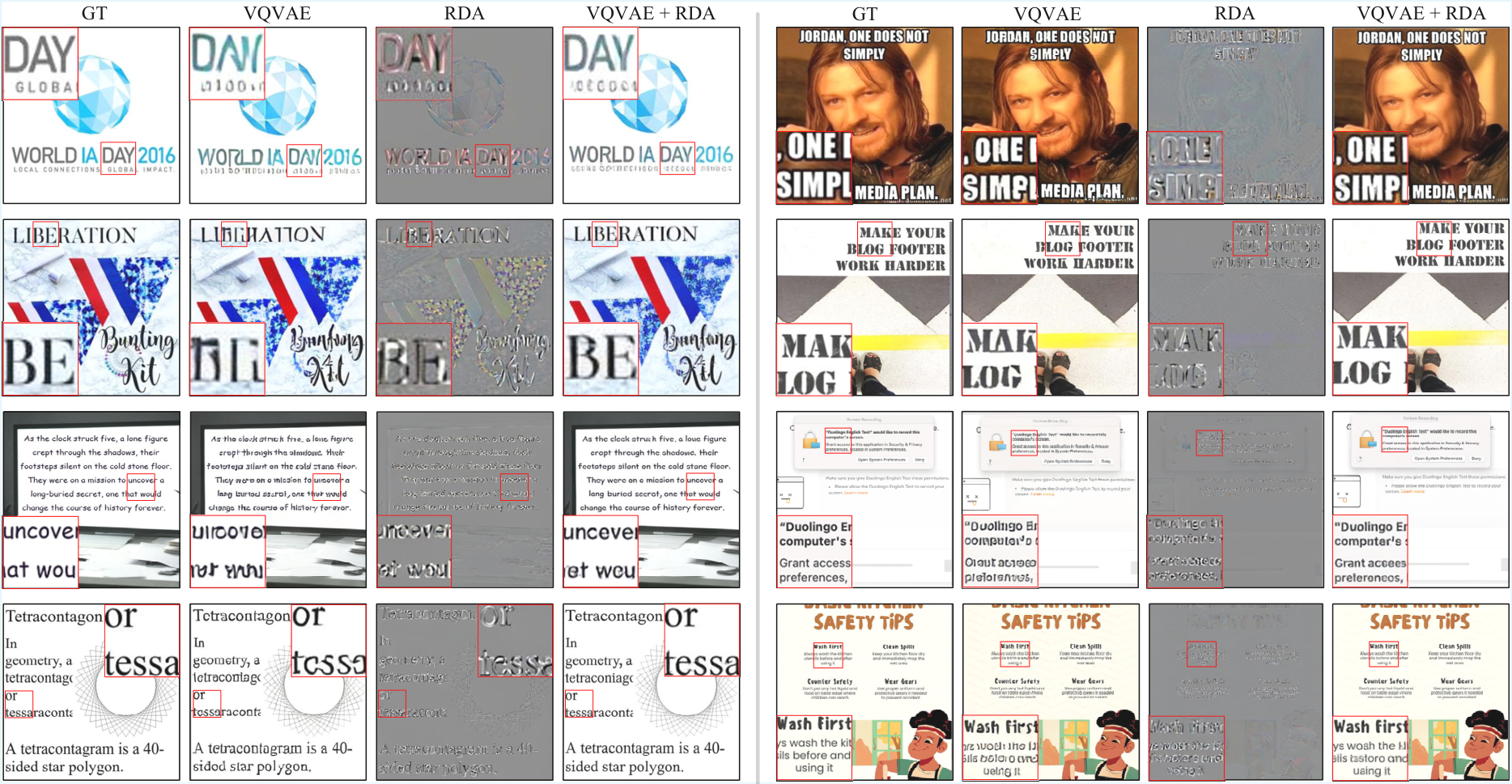
A compact analysis board for Table 3–6. Switch between reconstruction results and each ablation setting while keeping the same polished dataset-board layout.
@inproceedings{mao2026rda,
  title     = {Residual Decoder Adapter: Boosting AR Text Rendering without Retraining the Tokenizer},
  author    = {Mao, Dongxing and Wang, Alex Jinpeng and Tang, Jiahao and Lin, Kevin Qinghong and
               Li, Linjie and Yang, Zhengyuan and Wang, Lijuan and Li, Min and Tan, Jingru},
  booktitle = {Proceedings of the IEEE/CVF Conference on Computer Vision and Pattern Recognition (CVPR)},
  year      = {2026}
}